The Biscuit Factory is backFeb 17, 2020 12:00 am Sadiq gives the Duke of Westminster a second chance -We blogged back in 2018 about the redevelopment of the former Peek Freans biscuit factory and adjoining Bermondsey college campus site. Grosvenor Estate, headed by Hugh Grosvenor the 7th Duke of Westminster, London’s largest landowner and the world’s richest man under 30 (worth over £10bn), proposed 1,343 new homes, none of which were to be social rent. The site is next door to two Bermondsey wards with some of the most deprived neighbourhoods in the country and the complete lack of any social housing was too much for both local councillors and Southwark’s planning committee, who early last year rejected the scheme.
However, Mayor Sadiq Khan overrode Southwark’s decision by ‘calling it in’, citing Southwark’s failure to meet its affordable housing targets, and is now set to approve the scheme, after a public hearing at City Hall on the 21st February. Still no proper social rentThe original scheme has been amended, with an overall increase in the number of homes, by 206 units, including 160 affordable, up to 1,548 units in total. But because the scheme remains Build to Rent (BtR), with none of the homes for sale, there will still be no proper social rented housing. Instead 140 of the 160 affordable units will be ‘social rent equivalent’ (SRE) – a pseudo-social rent on 3-year tenancies, with just a ‘presumption’ of renewal, not the lifetime assured or secure tenancies of proper social rented housing. Even were we to accept SRE as social rent, the 140 SRE units still amount to less than 10% of the 1,548 total number of homes. The SRE rents will be Target Rents, which are higher than most Southwark council rents (eg one bed would be £134pw, compared to council rent of £107pw). The SRE service charges are unquantified, with only the assurance that they will be ‘controlled’ (para 249). Most of the affordable housing, though, is made up of Discounted Market Rent (DMR) – 343 units to be let at much higher rents than SRE, eg £354pw for a one-bed. It is not clear if these rents include service charge, There will be no units let at London Living Rent, the Mayor’s preferred rent level, which would have much reduced the DMR rents (para 250). (Another) non-viable development.At the bottom of the poor affordable housing offer is Grosvenor’s rehearsal of the well-worn developer claim that this is a non-viable development. A non-viable development is one where the developer’s own profit target is not met, not one where it makes no money. In this case Grosvenor’s profit target is 12% IRR, and they say they can make barely half that (6.53%) and the affordable housing offer is the best that they can do. GLA and Southwark agrees, but any confidence we can have in these judgements is undermined by huge disparity in the estimates of profits; Grosvenor estimated they would make a £189m loss on the original 2017 planning application, while Southwark said they would make £101m profit. Now Grosvenor claims a profit of £13m on the amended scheme. We don’t know the GLA’s profit estimate, because it hasn’t published its own appraisal, despite the Mayor’s commitment to transparency.
Early and late stage reviews of the scheme are offered and should there be any increase in profitability, extra social rent equivalent or London Living Rent homes will be provided, but only by reducing the DMR rents, not by converting market-rent units, so there will be no increase in the number of affordable units. Mayor misses 50% affordable housing opportunityIn October 2018 Southwark’s regeneration boss, Cllr Johnson Situ, commented on the original application: “With over 10,000 people on our housing waiting list it is very disappointing to see such a little amount of social or genuinely affordable housing in this application. As it stands, we are still a long way from agreeing a scheme that meets the council’s policies.” Southwark has followed this up by making a representation on the amended scheme to GLA, reiterating some of the objections that led to the original scheme’s rejection, but Southwark has not argued for the amount of real social rented housing that its own policy requires – 35% of the total amount of housing, 70% of which social rented housing – 30% intermediate. This would give us around 380 social rented homes and 162 DMR homes. Indeed, it is arguable that the affordable housing requirement should be nearer 50%, given that nearly three-quarters of the Biscuit Factory site is former industrial land. The GLA report recommending approval of the scheme skips lightly over the fact that such land should deliver 50% affordable housing, in line with the Mayor’s ‘strategic’ target (Policy H4, pg 188), by saying ‘the site currently comprises a privately-owned commercial complex, the previous industrial use having ceased over 30 years ago’ (para 232) and so is subject to a 35% requirement instead. While Southwark has been reduced to a bystander in the decision making, GLA has indulged in a pick n mix of the bewildering number of affordable housing policies (paras 220-236) and decided that only 140 pseudo-social rent homes need to be built, with 342 DMR at much higher rents – an exact reversal of the proportions of social to intermediate housing, required by Southwark’s policy. In sum, a Labour Mayor has called in a development that a Labour council has rightly refused because it has no social rented housing, ignored that council’s own affordable housing policies, and applied his own, weaker policies, all to help a developer build something without any proper social rented housing. Keeping Build to Rent rentedMany of the other BtR provisions are familiar from the proposed BtR development of the Elephant and Castle Shopping Centre. As at the Elephant a legal covenant is needed to ensure that the BtR development remains for rent, not for sale. The covenant for the Biscuit Factory is only for 20 years though, whereas Southwark required thirty years from developer Delancey for the shopping centre; in any event the covenant does not entirely stop a developer selling on, if they are prepared to pay a penalty, known as ‘claw-back’. Poor doorsBesides being BtR, there is much else not to like about the development. One of Sadiq Khan’s manifesto pledges was that he would ban poor door’s in London’s housing developments. He has held true on this pledge to the extent that separate entrances for private and affordable tenants are indeed a thing of the past and instead we now see entirely separate buildings (see Heygate, Aylesbury and most major schemes approved in last 5 years.) Grosvenor are following this trend, ‘consolidating’ most of the Biscuit Factory’s affordable housing into separate blocks.
Renewable energyDespite both the Mayor and Southwark Council having formally declared a ‘climate emergency’, Grosvenor’s scheme fails to comply with the either the Mayor’s or Southwark’s minimum 20% requirement for on-site renewable energy supply. Policy 5.7 (para 5.42) of the Mayor’s new London Plan requires that ” all major development proposals will seek to reduce carbon dioxide emissions by at least 20 per cent through the use of on-site renewable energy generation” via the use of “renewable energy technologies such as: biomass heating; cooling and electricity; renewable energy from waste; photovoltaics; solar water heating; wind and heat pumps”. Southwark’s sustainability policies also require this minimum 20% on-site renewable energy generation (see policy 13 of the Core Strategy) and Policy 3.5 of its Sustainability SPD:
Grosvenor’s Energy Assessment proposes just 0.7% renewable energy generation (see para 7.6) using a handful of solar panels and some air conditioning units in the commercial units that can also provide heat. Grosvenor also falls short of the London Plan’s zero-carbon requirement, opting to make a £1.137m payment in-lieu instead (para 470). More Build to Rent, less Social RentThe proposed Biscuit Factory development demonstrates why we do not have enough homes that people can actually afford to live in. It could deliver nearly 50% affordable housing, around 700 units of which nearly 500 would be social rented, if the Mayor abides by Southwark’s adopted policy and the site is treated as former industrial land. Even reduced to 35% affordable housing, applying Southwark’s policy would get around 380 social rented units. Instead it is only delivering 140 pseudo-social rent, plus 20 Discounted Market Rent. The Biscuit Factory also demonstrates the threat of BtR developments for social rented housing. Build to rent schemes do not provide social rented housing, only a pseudo-social housing and very little of it. The more Build to Rent schemes we have in London the less social rented housing there will be. The Mayor cited Southwark’s failure to meet housing targets as reason to call-in the application. This is justifiable, but his concern is headline figures, not meeting the priorities of local housing need, which in Southwark is for proper social rented housing (pg 67).
The Mayor’s pre-election manifesto promise was to build ‘genuine affordable housing’, including social rented housing, and he pledged to ‘support councils to…maximise the affordable housing’. The Mayor has also made much of his 50% affordable housing target. If Grosvenor’s proposals for the Biscuit Factor gets the go-ahead he will have failed to live up to all these promises, approved a scheme that has less than 10% genuinely affordable housing (if we were to accept ‘social rent equivalent’ as real social rent) and thwarted Southwark’s attempts to get anything better. |
35% Campaign.


 Extract from Grosvenor’s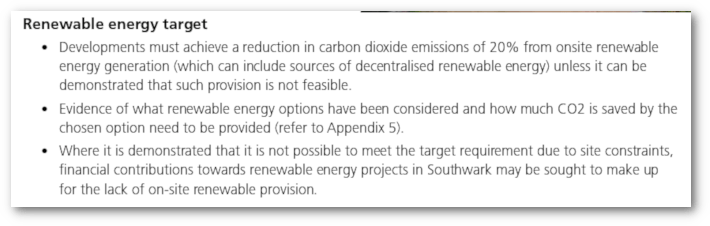



35% Campaign update – Elephant traders still homeless
Elephant traders still homelessJan 20, 2020 12:00 am Survey shows two-thirds of current traders have nowhere to go -As Delancey announces its intention to close down the E&C shopping centre, research by Latin Elephant has shown that only around 40 out of nearly 100 independent traders still operating at the centre have been allocated new premises. Latin Elephant’s interactive map, accompanied by supporting evidence, narrates the decline in trader’s numbers, up to late spring 2019. Latin Elephant’s figures show that there were originally 130 independent traders operating in January 2018, of whom only around 40 will be relocated, if the relocation strategy continues on its present course.
How many traders?The figure of 130 independent traders (ie traders with less than three outlets) was supplied by Southwark Council in January 2018 and later confirmed by officers at planning committee in July. These include market stallholders and businesses in Hannibal House, the office block above the centre, and all lie within the so-called ‘red-line’ of the proposed redevelopment area. Latin Elephant, with the assistance of petit elephant, then conducted its own survey in December 2018, just before the redevelopment was finally granted planning permission. This found only 97 traders remained indicating a loss of 30 traders over a few months. In March 2019, Southwark responded to a Freedom of Information (FOI) request, with a database of 79 ‘independent local operators’, eligible for relocation funds as defined by the legal agreement between Southwark Council and developer Delancey; Latin Elephant identified a further 21 independent businesses omitted from this list. Latin Elephant also consider that 17 more businesses are excluded from relocation funding, simply by the wording of the legal agreement. These includes sub-tenants in Arch 7, on Elephant Road, and small traders in the shopping centre that rent their space through third parties, such as Forum CentreSpace Ltd. In any event, in March 2019, Southwark confirmed that only 36 of the 79 ‘independent local operators’ had been offered a relocation unit. Not enough relocation spaceEven though Latin Elephant has voiced concerns about the shortage of relocation units on many occasions, both before and after planning approval, only 40 units are being provided on three sites. Latin Elephant identify 12 units in Perronet House, 8 in Elephant One, and 20 in Castle Square. In addition to these sites Southwark claim that Lendlease’s Elephant Park development (formerly the Heygate estate) offers 1,350 sq m of affordable retail space, but this only equates to eight units, at most. To date, none of the Elephant Park units has been offered to traders affected by the shopping centre redevelopment, according to an FOI response to a Southwark Law Centre question. Thirty market pitches in East St market were also suggested by Delancey in its planning application, but these are nearly a mile away and have never been delivered. Unfit databaseDelancey has also a legal obligation to maintain a database of vacant retail properties and make it available to eligible traders. Even though Southwark Council says on its regeneration webpage that properties are in the borough and within one mile of the shopping centre, petit elephant found that as of June 2019 many did not meet these criteria. Moreover, many demanded rents between £50,000 and £100,000 per annum, which Latin Elephant has already submitted are beyond the means of small-sized businesses. The whole list of 54 relocation units in the database is here. So, the best-case scenario is that less than half of all independent traders within the red line have been relocated to premises that might be more or less suitable for their businesses, with all other traders looking at options some distance away and/or too expensive. Not enough moneyAnother obstacle to successful relocation is the cost of moving, fitting-out new premises and re-establishing the business. The relocation fund provided by Delancey stands at £634,700, with a vague commitment to an unspecified greater amount, after ‘all claims have been properly assessed’ and ‘taking into account genuine trader hardship’. This averages out at a £17,630 per trader, given thirty-six traders and a very modest £8,034, given 79 traders. In fact, the costs will of course vary, according to size and other needs. By way of example, one business was quoted £121,000 including VAT, for the fit-out works of a 65 sq m unit at Elephant Park.
Feeble enforcement from Southwark CouncilThe trader’ relocation strategy was inadequate from the start, with too little space to move to and too little money to do it with, but it has been made worse by ineffectual enforcement by Southwark Council. The relocation process is effectively controlled by Delancey and, in the case of Elephant Park premises, fellow developer Lendlease. Both developers have obligations to provide affordable retail premises to shopping centre traders, under their respective legal s106 development agreements with Southwark Council. Southwark therefore has the power to take action if it thinks that these obligations are not being fulfilled. Traders complain that this is indeed the case, with shopping centre traders not fitting the retail profile required by Delancey and Lendlease for the new Elephant developments. Southwark Law Centre has taken up the case of one trader, refused premises because of the nature of their trade. Even those traders who have been allocated space have justifiable complaints about its size, cost and position – all critical factors for successfully continuing business. In particular, there are complaints about Perronet House. Despite being owned by Southwark Council, who is thus the traders’ new landlord, both the service charges and rent will be higher there than those for Castle Square, the relocation site owned by Delancey. For example, the rent of a 26 sq m unit on the ground floor in Castle Square is £6,768 per annum, plus £2,256 of service charge (£8 per square foot), while Southwark Council offers a 25.7 sq m unit in Perronet House at an average of £7,645 over 5 years, with an ‘estimated’ service charge of £3,047 (£11 per sq ft). What information does Southwark Council hold?Several FOI requests have been made to Southwark, in pursuit of information about the traders’ relocation. The latest request is for information about which traders have succeeded in their relocation requests (thirty-six in number), those refused (28 in number), those who have left the Elephant and Castle, plus the 130 Elephant traders initially identified by Southwark, back in January 2018. Perhaps unsurprisingly this request has been refused, on the grounds that it would prejudice the commercial interests of unspecified third parties; an appeal has been made against the decision. A bad tale continuesAn Evening Standard article, enthusiastically endorsed by Southwark Council leader Peter John, tells the shopping centre redevelopment story that developer Delancey wants the world to believe in – new homes, new jobs, ‘funky street food’. Through their diligent research Latin Elephant and petit elephant tell a different story; one of neglect and broken promises. The independent traders, their families, customers and the social fabric they have built over many years is being pulled apart to enable Delancey and Southwark’s idea of a bright future. But it is not too late for Southwark to partly redeem themselves – the traders need more space and more money for their relocation fund. Delancey (and Lendlease) are well able to provide it. Delancey’s anticipated profit from the shopping centre redevelopment is at least £137.1m. The Up the Elephant campaign will be holding a stall on Saturday, 25 January 11.30pm just outside the former Charlie Chaplin pub, on the New Kent Rd side of the shoppin centre. There will also be a demonstration, organised by the Up The Elephant campaign, in support of the traders’ deputation to Southwark Council’s first assembly meeting of the year on Tuesday 28 January Southwark Council Head Offices, Tooley St 6pm – everyone who wants a fairer, inclusive regeneration at the Elephant is welcome. |


Up the Elephant Public Meeting 19 Nov 2019
Dear Friend
Many thanks to everyone who came along and supported the campaign at the Judicial Review. We had great turn-out – over 40 people – many staying on to hear the case itself. Special thanks to Distriandina for a heartening breakfast!
Now we wait for Justice Dove’s decision, which should be in two or three weeks. In the meantime we must talk about what happens next. Whether we win our lose, there will be much to do, supporting the traders and fighting for an inclusive development that benefits local people.
We are therefore holding a public meeting on Tues 19 November, 7pm, Draper TRA Hall, Hampton Street Junction with Newington Butts
(next to the Santander bike stand) SE17 3AN, more details, including speakers, below – please join us!
Regards
Jerry

FB event and map here- please share
For updates go to https://twitter.com/UpTheElephant_
Copyright © 2019 Elephant Amenity Network, All rights reserved.
You are receiving this email because you signed a petition and said “I want to help” or you asked to go on our mailing list.
Our mailing address is:
Elephant Amenity Network
18 Market Place
Blue Anchor Lane
London, Southwark SE16 3UQ
United Kingdom
Tomorrow – shopping centre plan goes to court
Dear Friend
A reminder that developer Delancey’s destructive plans for the redevelopment of the Elephant shopping centre will be tested in court tomorrow.
Meet us for a solidarity breakfast of hot drinks and breakfast rolls from 7.30 am at Distriandina, Arch 6 Elephant Rd, just along from the Elephant overground station.
Our coach will stop to pick us up, then rolling round the corner to pick up people from the Metropolitan Tabernacle at 8am prompt.
To reserve a place on the coach please call or text 07792 786 192.
We will travel to the Royal Courts of Justice, the Strand, Holborn, London WC2A 2LL and have a demonstration of support at 9am. The case then starts at 10am. You can stay for as long as you wish – the case is open to the public.
Please join us and spread the word – Facebook event page here!
We want as many supporters as possible to come along, to show the strength of our campaign for more social housing and a better deal for traders and a better deal for the local community at the Elephant.
You can read more about our case here.
Hope to see you tomorrow!
Regards
Jerry

35% Campaign update – High Court hearing looms for Elephant shopping centre
High Court hearing looms for Elephant shopping centre
Oct 17, 2019 12:00 am
Legal challenge goes to court next week –

The legal battle to quash the planning permission for the demolition and redevelopment of the shopping centre reaches the High Court next week, when a judicial review hearing is scheduled for the 22 and 23 October, after being postponed from July. The challenge is supported by the Up the Elephant campaign, the Public Interest Law Centre and Southwark Law Centre, as well as by the 35% Campaign. The challenge will be presented by barristers Sarah Sackman of Francis Taylor Building and David Wolfe QC of Matrix Chambers.
A demonstration of support is being held on Tues 22 October 9am, outside the Royal Courts of Justice, Strand, WC2A 2LL. There is a free coach to the protest – departing 8am, from outside the Metropolitan Tabernacle, opposite the Northern line tube station (text/phone 07792786192 to reserve a place).
Traders are being lost
The High Court will decide whether or not Southwark Council’s decision to award planning permission to offshore developer Delancey was lawful. Delancey proposes to build shops, homes and much else besides, including a new Northern Line tube entrance and new college campus for the London College of Communication. But Delancey’s big plans have very little in them for local people, those who are living and working at the Elephant now.

The much-loved bingo hall has already gone and is unlikely to return. If the shopping centre is demolished it will displace all the traders from the world over who have made the Elephant their home. Demolition will also destroy a social hub for London’s Latin American community and nowhere near enough has been done to mitigate the consequences of this. Latin Elephant, with the help of Petit Elephant, have made a detailed study of what is happening to all the traders and they estimate that almost fifty traders have not been given relocation space and will have nowhere to go.
 Latin Elephant’s detailed interactive map and list of traders with nowhere to go
Much more social rented housing needed
While we are losing the small traders, Delancey’s ‘mixed-use’ development is denying us the one kind of housing we most need – social rented housing. The Up the Elephant campaign has gradually driven up Delancey’s social housing offer from 33 ‘social rent equivalent’ units to 116 proper social rent, but this is still a very small number out of the 979 total number of new homes.
Next week’s legal challenge will argue that Southwark’s Council’s planning committee was misled about the maximum amount of affordable housing the scheme could viably provide. Delancey said it could only afford to provide 116 social rented homes, but we now know that with Mayor’s funding they could give us another 42 much needed homes.
Even the 116 social rented homes promised could be at risk; the devil is in the detail and Delancey has managed to pull the wool over the Council’s eyes, with a legal (s106) agreement that could leave us with little or no social rented housing if Delancey chooses not to deliver the latter part of the scheme, which in any case is not due to be built for another 10 years.
Join Us!
We should be getting something much better than this. The regeneration of the Elephant has already lost us over a thousand council homes, from the demolished Heygate estate. The shopping centre is the last major site within the Elephant and Castle Opportunity Area – it should be making up much more of these losses. The benefits of the redevelopment in the shape of the new tube station and new college campus should not be at the expense of social rented housing.
The Up the Elephant campaign has fought tirelessly for nearly 3 years to get more social rented housing and a better deal for the independent traders; it has shown that we can make gains. As well as the extra social housing, traders have got more affordable retail space, a relocation fund and a temporary facility on Castle Square – but it is not enough to make Delancey’s development one that really benefits everyone at the Elephant.
So, please join us on 22 October to show your support for our battle!
Text/phone 07792 786192 to reserve a coach place.
You can still also donate to our crowdfunding appeal
For a brief history of the controversy surrounding Delancey’s scheme, check out part 1 of Emile Burgoyne’s recently released film – ‘Why do Elephants keep developing?’](https://youtu.be/EQ2M6_vQo2s):

E&C Shopping Centre campaign goes to court next week
Dear Friend
You are invited to join us on the Elephant and Castle Shopping Centre Judicial Review Express!
Our legal challenge against the Elephant Shopping Centre planning permission goes to court next week – on Tues 22nd October – and we have hired a coach to take all our supporters along.
Coach pick-up is at 8am prompt, outside the Metropolitan Tabernacle, opposite the E&C tube station.
To reserve a place on the coach please call or text 07792 786 192.
We will travel to the Royal Courts of Justice, the Strand, Holborn, London WC2A 2LL and have a demonstration of support at 9am. The case then starts at 10am. You can stay for as long as you wish – the case is open to the public.
Please join us and spread the word – Facebook event page here!
We want as many supporters as possible to come along, to show the strength of our campaign for more social housing and a better deal for traders and a better deal for the local community at the Elephant.
You can read more about our case here.
Hope to see you next Tues!
Regards
Jerry
|
||||||||||||||||
|


35% Campaign update – Canada Water regeneration finally up for approval
|
||||||||||||||

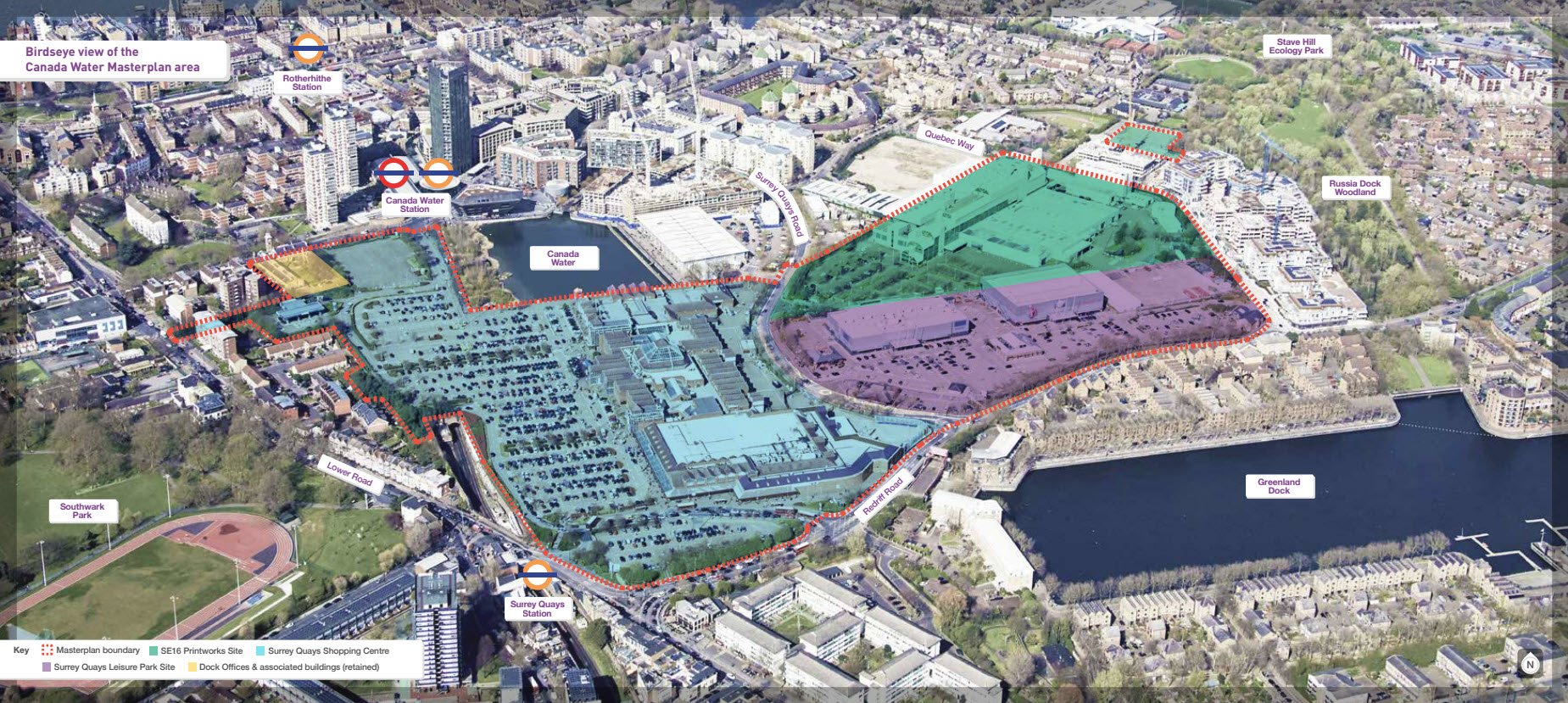 Canada Water Shopping Centre (shaded blue), Print Works (shaded green), Leisure park (shaded purple)
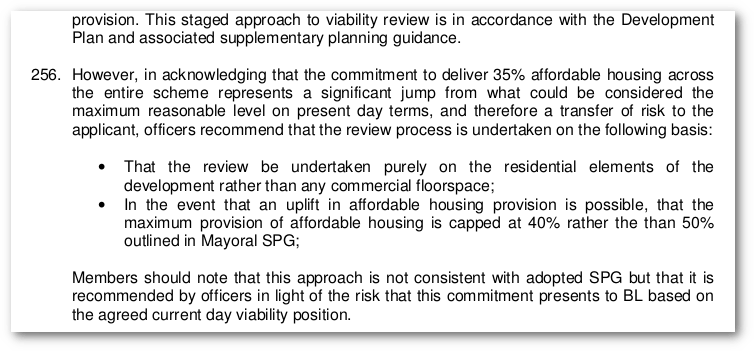 Extract from the
  British Land’s
 35% Campaign update – Elephant Park MP5 – the final chapter
|
|||||||||||||||
 Figures for the total and affordable units proposed in
 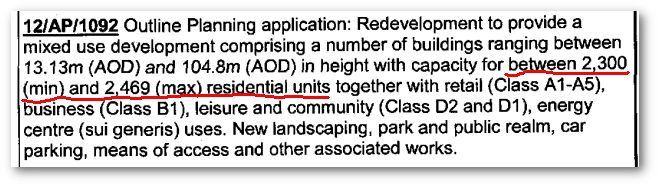 Development description from
 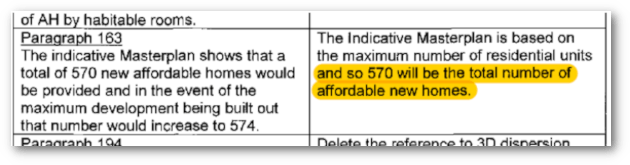 Extract from the addendum to the
  Extract from Lendlease’s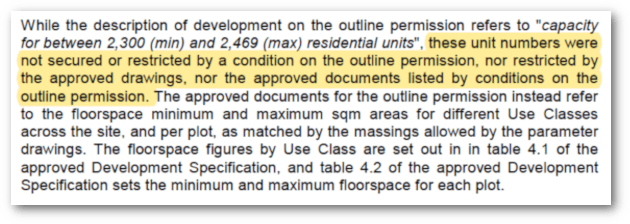
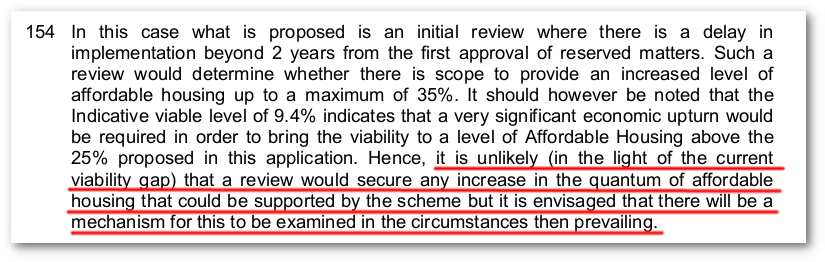 Extract from the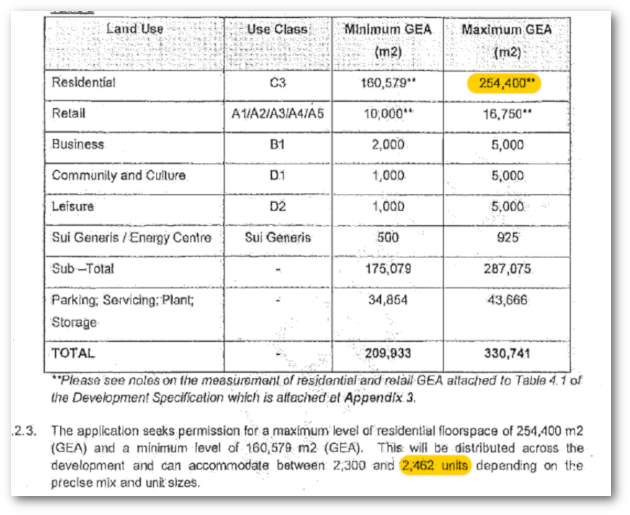


Shopping centre legal challenge next week!
|

35% Campaign update – Why we’re challenging the Elephant & Castle redevelopment plans in court
|
|||||||||||||||||


 Tabard Gardens North T&RA