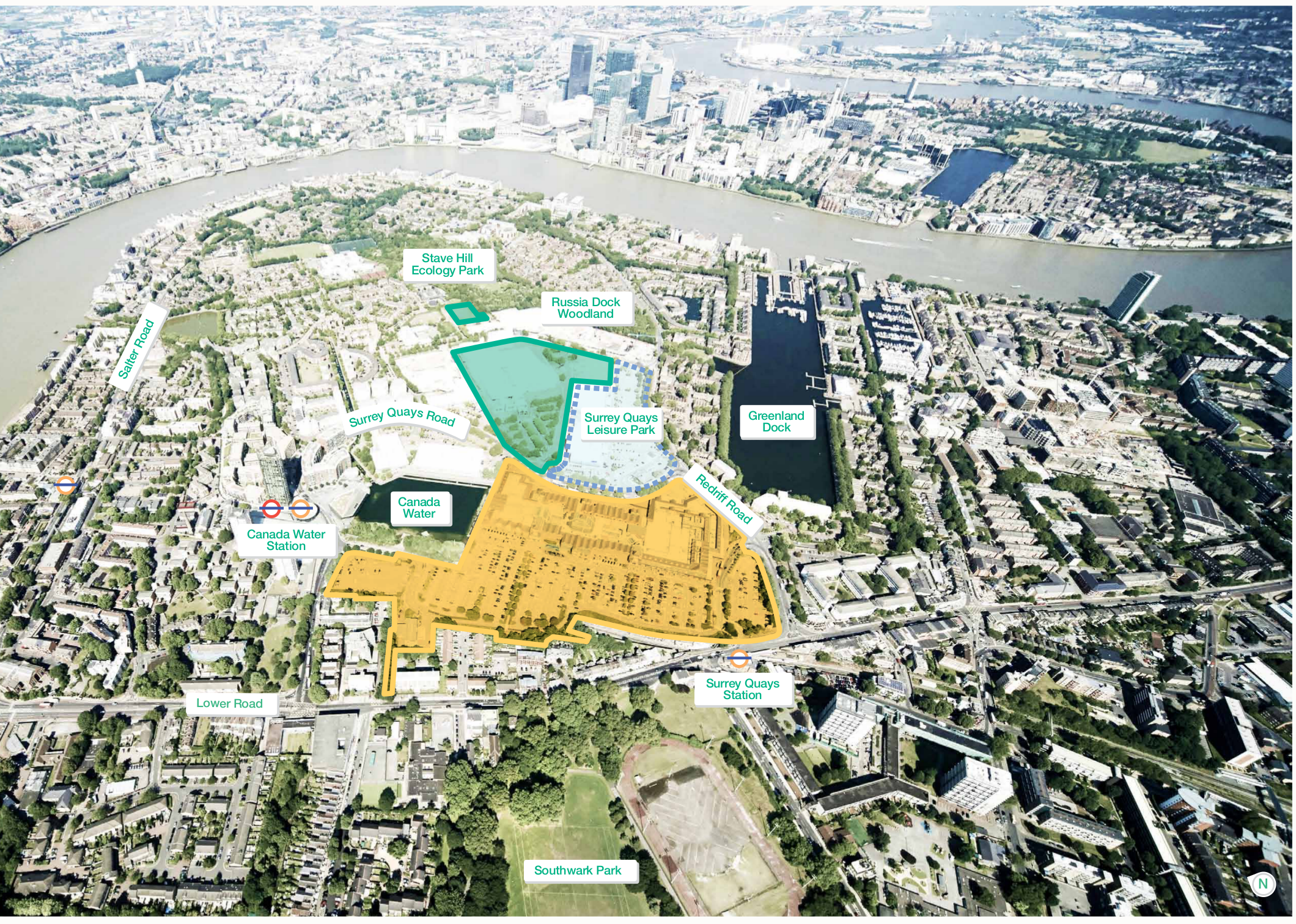
Sep 17, 2021 01:00 am Southwark to change rules to allow office block on former Heygate estate.Southwark Council is set to change its planning rules to enable developer Lendlease to build an office block on the site of the former Heygate estate. The block would be on the final development plot of Elephant Park, Plot H1, which is earmarked for housing under Lendlease’s current planning consent. Lendlease has now applied to replace this consent with an entirely new one, to build an office block, not housing.  Southwark is also ready to change the New Southwark Plan (NSP) to pave Lendlease’s way to a successful approval of the application. The change will allow an increase in the office floorspace on Elephant Park, from the maximum of 5,000 sqm that Lendlease is presently allowed, to the 49,565 sqm it is proposing in its new planning application. Southwark has said ‘an office development on this plot is broadly supported’ in the ‘Conclusion’ of pre-application discussions with Lendlease.Late changes to the New Southwark PlanThe change to the NSP, which governs all development throughout the borough, is part of a ‘main modification’ to the Plan. The modification MM7 would allow 60,000 sqm of ‘employment floorspace’ to be built specifically on Elephant Park; at the moment the local plan envisages a maximum of 30,000 sqm of ‘business floorspace’ for the whole Elephant and Castle Opportunity Area.The NSP, including the main modifications, is in the final stages of approval by government inspectors. Comments on all proposed modifications can be made up to a deadline of 24 September 2021.From open space to office spaceA good part of Plot H1 sits on land that was covenanted for use as open space, in perpetuity, when ownership was devolved to Southwark in 1985, on the abolition of the Greater London Council (GLC). In 2014 Southwark transferred ownership of the Heygate land, including Plot H1, to Lendlease, removing the covenant in the process. Southwark is also ready to change the New Southwark Plan (NSP) to pave Lendlease’s way to a successful approval of the application. The change will allow an increase in the office floorspace on Elephant Park, from the maximum of 5,000 sqm that Lendlease is presently allowed, to the 49,565 sqm it is proposing in its new planning application. Southwark has said ‘an office development on this plot is broadly supported’ in the ‘Conclusion’ of pre-application discussions with Lendlease.Late changes to the New Southwark PlanThe change to the NSP, which governs all development throughout the borough, is part of a ‘main modification’ to the Plan. The modification MM7 would allow 60,000 sqm of ‘employment floorspace’ to be built specifically on Elephant Park; at the moment the local plan envisages a maximum of 30,000 sqm of ‘business floorspace’ for the whole Elephant and Castle Opportunity Area.The NSP, including the main modifications, is in the final stages of approval by government inspectors. Comments on all proposed modifications can be made up to a deadline of 24 September 2021.From open space to office spaceA good part of Plot H1 sits on land that was covenanted for use as open space, in perpetuity, when ownership was devolved to Southwark in 1985, on the abolition of the Greater London Council (GLC). In 2014 Southwark transferred ownership of the Heygate land, including Plot H1, to Lendlease, removing the covenant in the process.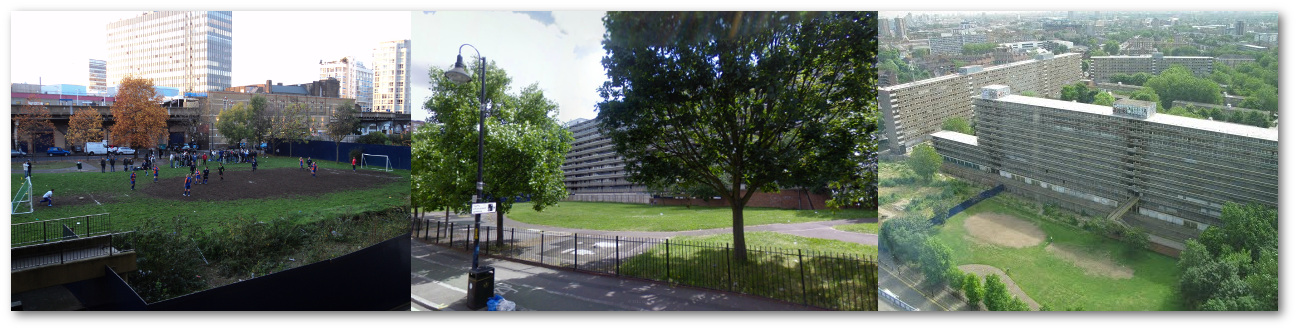 In 2019 Lendlease took advantage of a poorly drafted s106 legal agreement with Southwark to increase the maximum number of homes allowed on Elephant Park by 220 units, to 2,689. Lendlease is using ten plots of land for these homes, instead of the eleven available, leaving itself a spare plot. This is the justification for the new planning application – Lendlease claims that they have fulfilled their housing obligations under the current planning consent, so Plot H1 can be used for an office development, which would create jobs.Lendlease does not say in their new planning application how many homes could be built on Plot H1, if it were used for housing as originally intended, but by making a rough comparison with neighbouring plot H7, a capacity for about 340 homes can be calculated.Lendlease on manoeuvresLendlease’s Plot H1 planning application is the latest of a succession of self-advantageous manoeuvres. As well as increasing the number of homes on the estate and squeezing them into fewer plots, Lendlease has also announced that over 900 of the free-market homes would no longer be for sale, but kept under their ownership, and let to private renters, not sold. Before this, they marketed and sold substantial numbers of homes overseas . This all followed the notorious 2010 Heygate regeneration agreement, which reduced the affordable housing to 25%, from 35%, with a meagre 79 social rented units (later inching up to 100 units).Southwark Council is now poised to give up a prime housing site (in the middle of an opportunity area, on former council estate land) at Lendlease’s behest. Southwark is doing this while embroiled in controversies across the borough about infill development on council estate sites, none of which are anywhere near the size of the plot it is about to give up. In 2019 Lendlease took advantage of a poorly drafted s106 legal agreement with Southwark to increase the maximum number of homes allowed on Elephant Park by 220 units, to 2,689. Lendlease is using ten plots of land for these homes, instead of the eleven available, leaving itself a spare plot. This is the justification for the new planning application – Lendlease claims that they have fulfilled their housing obligations under the current planning consent, so Plot H1 can be used for an office development, which would create jobs.Lendlease does not say in their new planning application how many homes could be built on Plot H1, if it were used for housing as originally intended, but by making a rough comparison with neighbouring plot H7, a capacity for about 340 homes can be calculated.Lendlease on manoeuvresLendlease’s Plot H1 planning application is the latest of a succession of self-advantageous manoeuvres. As well as increasing the number of homes on the estate and squeezing them into fewer plots, Lendlease has also announced that over 900 of the free-market homes would no longer be for sale, but kept under their ownership, and let to private renters, not sold. Before this, they marketed and sold substantial numbers of homes overseas . This all followed the notorious 2010 Heygate regeneration agreement, which reduced the affordable housing to 25%, from 35%, with a meagre 79 social rented units (later inching up to 100 units).Southwark Council is now poised to give up a prime housing site (in the middle of an opportunity area, on former council estate land) at Lendlease’s behest. Southwark is doing this while embroiled in controversies across the borough about infill development on council estate sites, none of which are anywhere near the size of the plot it is about to give up. Object!Lendlease’s argument that offices will good for employment is entirely self-serving. They did not make this proposal for Plot H1 in 2012, when applying for their first planning permission. Instead, they have tricked their way into a position where they have built more homes than originally consented, on a smaller space, and now want to squeeze in an extra office block for good measure.Southwark Council have aided Lendlease’s application by proposing a ten-fold increase in ‘employment space’ on Elephant Park, in the New Southwark Plan – a huge uplift, introduced to boost the chances of an office-space application being approved.There has been much speculation about whether Southwark’s recent change of leadership has resulted in a change of direction for the Council.This is the planning committee’s chance to prove that the Council won’t roll over to Lendlease indefinitely. The committee must stop this cynical attempt to manipulate planning policy to Lendlease’s advantage and reject this planning application.Once this is done, Southwark should start a sensible discussion on what is to be done with this prime site, with the focus on the local community’s real needs, including affordable housing, with all the amenities and open surroundings needed to make life liveable in London.470 comments and objections have been made to this application.If you would like to add your objection, you can do so here.You can use this model objection text or view our full letter of objection here. Object!Lendlease’s argument that offices will good for employment is entirely self-serving. They did not make this proposal for Plot H1 in 2012, when applying for their first planning permission. Instead, they have tricked their way into a position where they have built more homes than originally consented, on a smaller space, and now want to squeeze in an extra office block for good measure.Southwark Council have aided Lendlease’s application by proposing a ten-fold increase in ‘employment space’ on Elephant Park, in the New Southwark Plan – a huge uplift, introduced to boost the chances of an office-space application being approved.There has been much speculation about whether Southwark’s recent change of leadership has resulted in a change of direction for the Council.This is the planning committee’s chance to prove that the Council won’t roll over to Lendlease indefinitely. The committee must stop this cynical attempt to manipulate planning policy to Lendlease’s advantage and reject this planning application.Once this is done, Southwark should start a sensible discussion on what is to be done with this prime site, with the focus on the local community’s real needs, including affordable housing, with all the amenities and open surroundings needed to make life liveable in London.470 comments and objections have been made to this application.If you would like to add your objection, you can do so here.You can use this model objection text or view our full letter of objection here.Read in browser » Recent Articles:Former Council leader glides through revolving doors Legal battle for the Elephant and Castle shopping centre ends Southwark rips up Aylesbury Area Action Plan Action on Southwark’s empty homes |
| follow on Twitter | friend on Facebook | forward to a friend 35% Campaign |
Neighbourhood Development
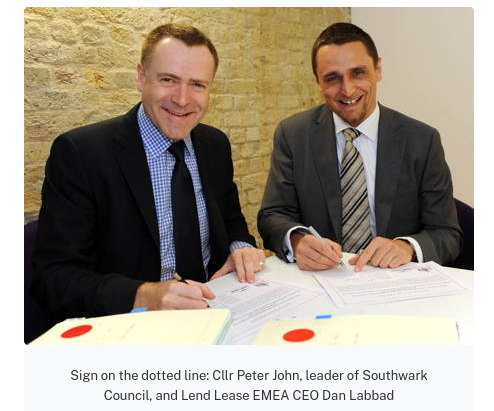
35% Campaign update – Former Council leader glides through revolving doors
|
|||||||||||||||||






Elephant Shopping centre decision
|


35% Campaign update – Southwark rips up Aylesbury Area Action Plan
|
|||||||||||||||




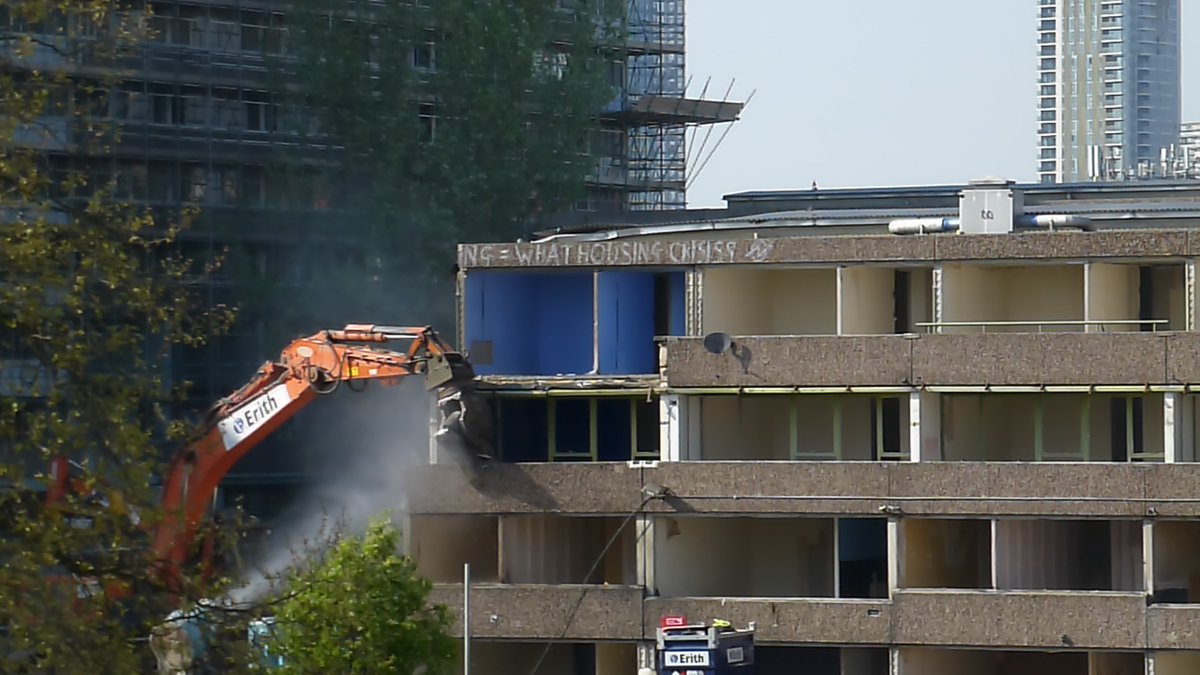
 Lights out on the redeveloped Heygate estate.
Tabard Gardens North rooftop extensions – update March 2021
Southwark Council has updated the rooftop extensions programme first mentioned in May 2020, increasing the number of blocks affected from 3 (Betsham, Boughton, Brenley) to 5 (adding Balin and Northfleet), plus a new ‘infill’ block on Tennis Street.
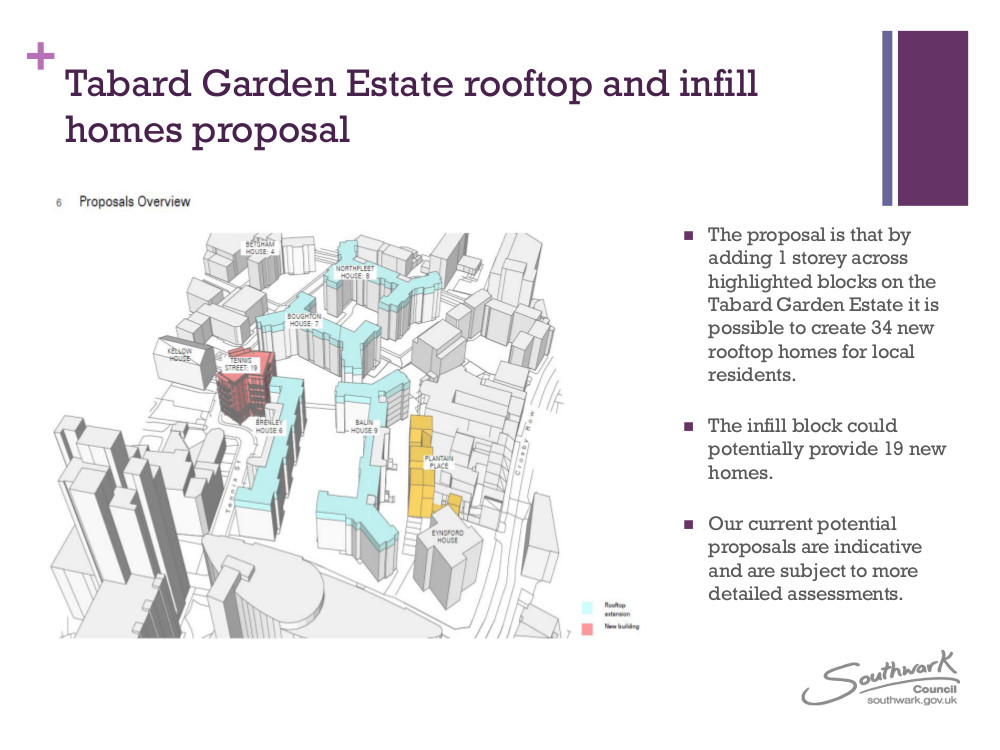
A newsletter to inform residents of these changes has gone out this week , available here:
Rapid testing, Bakerloo Line update and more
|
35% Campaign update – Social Rent or Affordable Rent?
|
|||||||||||||||||
 Guardian article including our findings at the Neo-Bankside development
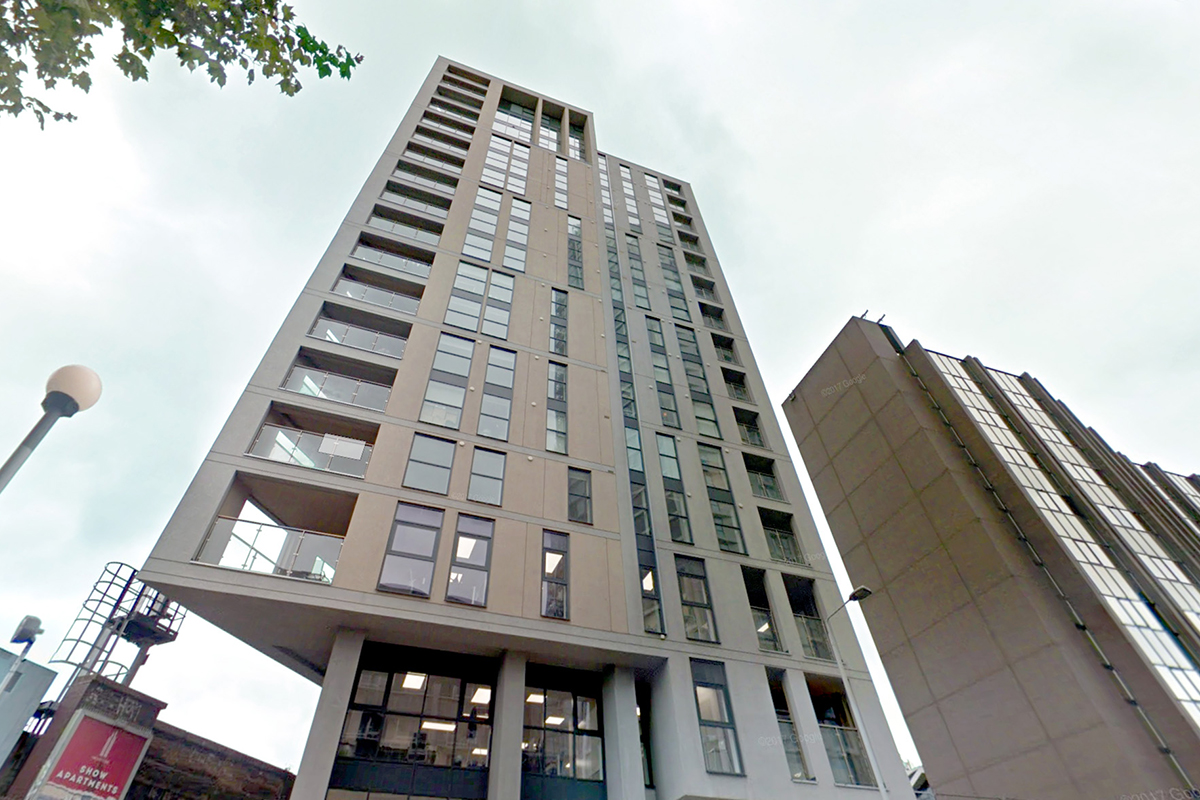 The Signal Building at Elephant & Castle where affordable homes were let at market rent and then sold on the open market
 Extract from the Council’s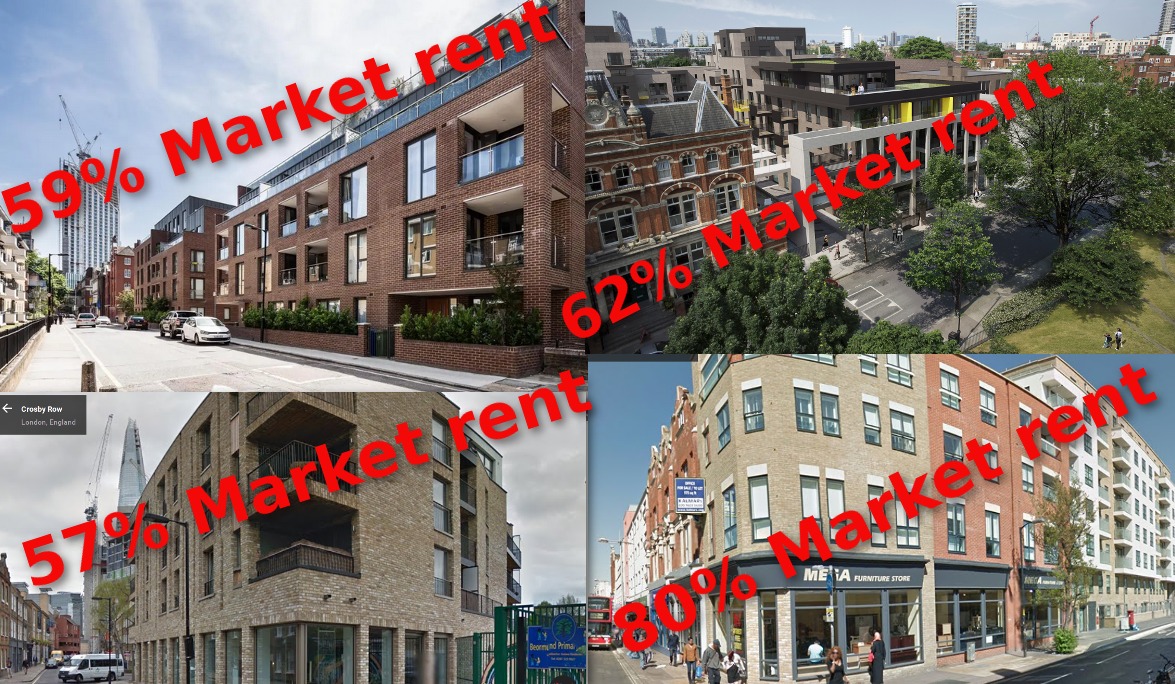


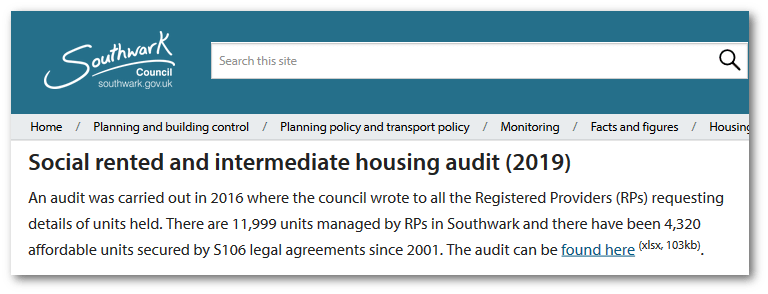
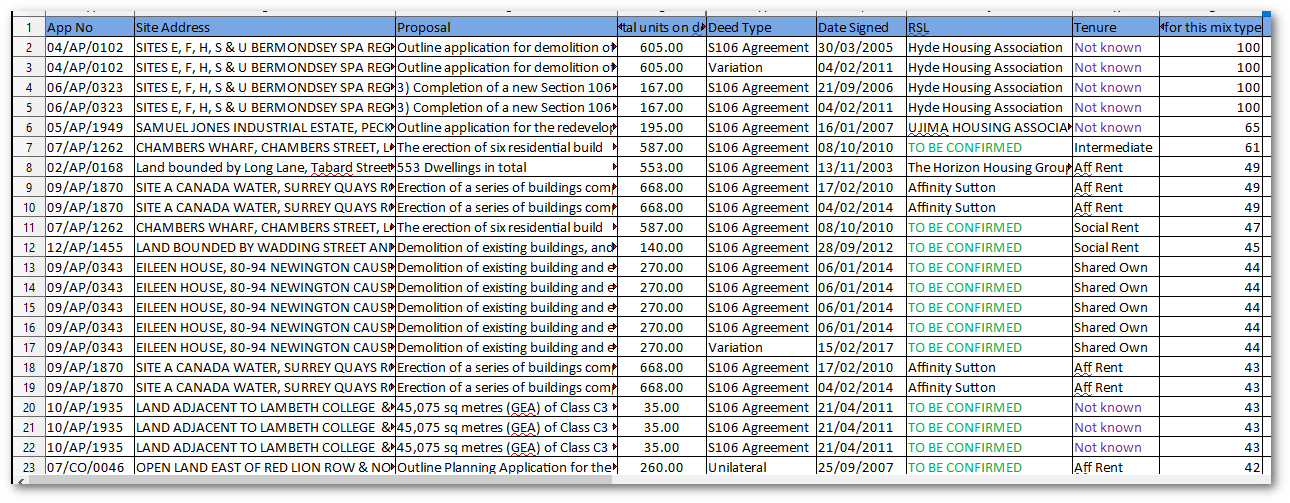
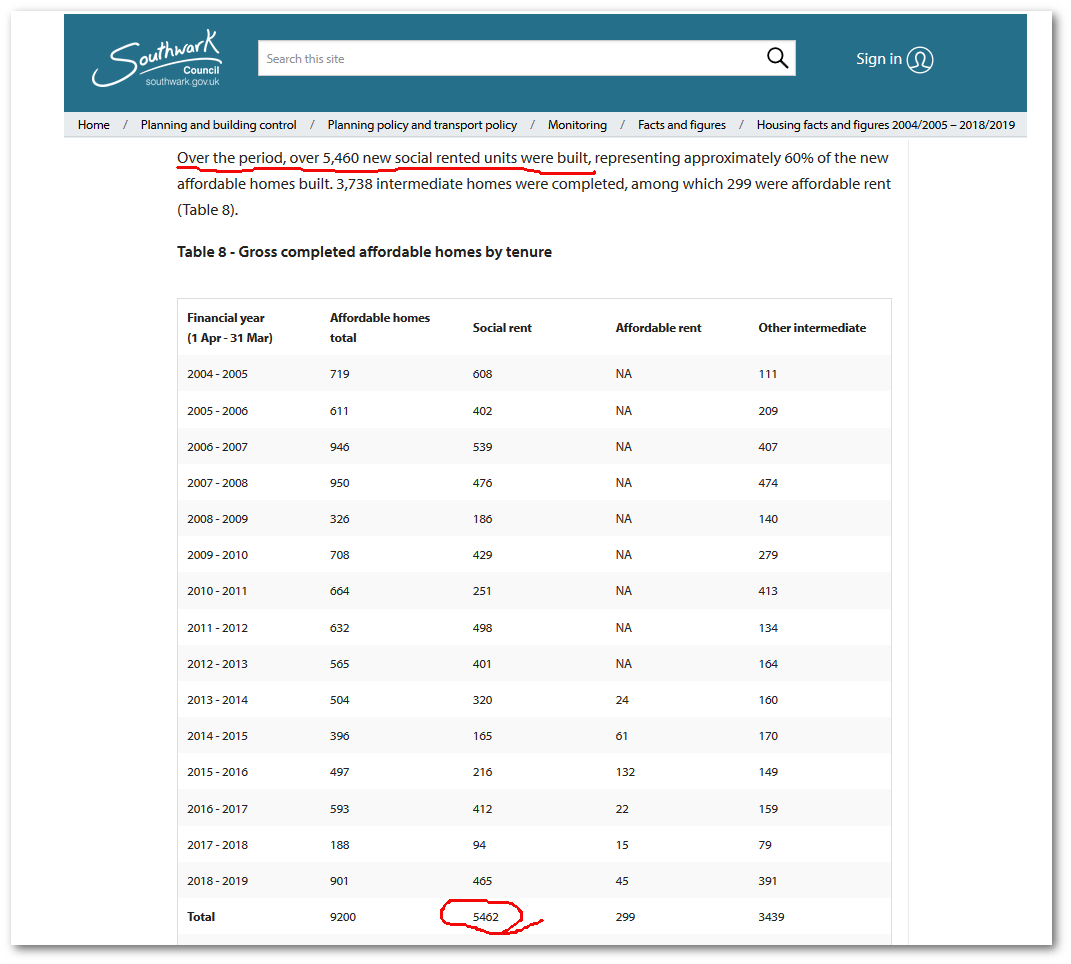 Southwark’s website
 35% Campaign update – No room for social rent at Pocket Living on the Old Kent Road
| No room for social rent at Pocket Living on the Old Kent Road Oct 06, 2020 12:00 am 100% affordable housing, zero social rent, zero family housing -Southwark Council is set to approve a mixed-used residential scheme in the Old Kent Rd Opportunity Area with no social rented housing or family housing, at its planning committee meeting this evening. 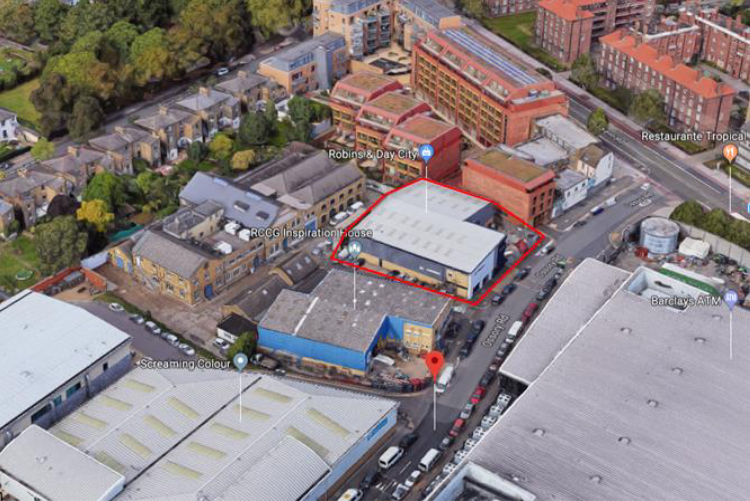 The proposed development on Ossory Rd is for 105 units of housing, with light industrial space beneath this. All 105 units will be affordable housing, but of the most expensive type, sold at 80% market value. The applicant is Pocket Living, which specialises in maximising the amount of housing on small sites. All the homes will be one-bed, one person units, without family housing. This is the second such Pocket Living development in the area; the first, in Varcoe Rd had 57 units and a third, Credon House, also for 57 units is in the pipeline. The proposed development on Ossory Rd is for 105 units of housing, with light industrial space beneath this. All 105 units will be affordable housing, but of the most expensive type, sold at 80% market value. The applicant is Pocket Living, which specialises in maximising the amount of housing on small sites. All the homes will be one-bed, one person units, without family housing. This is the second such Pocket Living development in the area; the first, in Varcoe Rd had 57 units and a third, Credon House, also for 57 units is in the pipeline.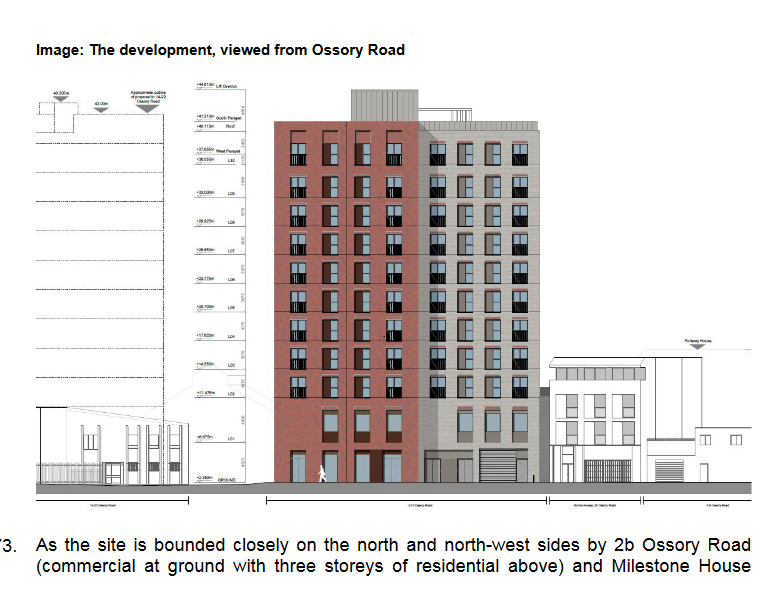 Pocket Living make up their own rulesSouthwark Council requires 35% affordable housing, 70% of which should be social rented, on all developments of this size. This has been the case since 2007 and the requirement has been retained in a succession of local planning documents, up to the draft New Southwark Plan and the Old Kent Rd Area Action Plan. All major approved developments within the Old Kent Rd have pledged to deliver that amount.There should also be at least 20% family housing of 3, 4, 5-beds in major developments and 60% of should comprise 2-bed homes1.Pocket Living, however, want to make up their own rules. Their sites are small and it wishes to maximise the number of homes built, so they are all one -bed/one person units, though 10% of their occupants appear to be couples, with most units barely above the minimum size allowed (37 sq metres) 2.The amount of open and amenity space for occupants is also squeezed. In a development of this size there should be 1,050 sqm private amenity space, Pocket are providing a miniscule 42 sqm. Developers can compensate for a lack of private space with more communal space, but Pocket falls well short here, too, providing less than half the amount required (506 sqm instead of 1,058 sqm) 3 .Not that affordablePocket Living justify their radical departures from Southwark’s affordable housing requirements, by claiming they are serving the hard-pressed, young first-time buyer and supply their own statistics and census figures to back this up, dutifully reproduced by the officer’s report, which recommends approval of the scheme 4. The report also makes the confusing claim that the affordable housing offer is policy compliant: Pocket Living make up their own rulesSouthwark Council requires 35% affordable housing, 70% of which should be social rented, on all developments of this size. This has been the case since 2007 and the requirement has been retained in a succession of local planning documents, up to the draft New Southwark Plan and the Old Kent Rd Area Action Plan. All major approved developments within the Old Kent Rd have pledged to deliver that amount.There should also be at least 20% family housing of 3, 4, 5-beds in major developments and 60% of should comprise 2-bed homes1.Pocket Living, however, want to make up their own rules. Their sites are small and it wishes to maximise the number of homes built, so they are all one -bed/one person units, though 10% of their occupants appear to be couples, with most units barely above the minimum size allowed (37 sq metres) 2.The amount of open and amenity space for occupants is also squeezed. In a development of this size there should be 1,050 sqm private amenity space, Pocket are providing a miniscule 42 sqm. Developers can compensate for a lack of private space with more communal space, but Pocket falls well short here, too, providing less than half the amount required (506 sqm instead of 1,058 sqm) 3 .Not that affordablePocket Living justify their radical departures from Southwark’s affordable housing requirements, by claiming they are serving the hard-pressed, young first-time buyer and supply their own statistics and census figures to back this up, dutifully reproduced by the officer’s report, which recommends approval of the scheme 4. The report also makes the confusing claim that the affordable housing offer is policy compliant: Buying a decent home in London is undoubtedly hard for the young professionals Pocket Living housing is squarely aimed at, but they are still relatively much better off than those excluded by the absence of social and family housing from Pocket Living developments. Pocket’s typical purchaser will have an average income of £44,000 (OR, Para 60), an income enjoyed by less than 4.5% of Southwark’s households. Pocket Living estimates that its homes will sell for approximately £300k each (with the 20% discount). Supplying homes at these prices to those who earn £44k per year, at the expense of those who earn barely half that is not what affordable housing should be about5. Buying a decent home in London is undoubtedly hard for the young professionals Pocket Living housing is squarely aimed at, but they are still relatively much better off than those excluded by the absence of social and family housing from Pocket Living developments. Pocket’s typical purchaser will have an average income of £44,000 (OR, Para 60), an income enjoyed by less than 4.5% of Southwark’s households. Pocket Living estimates that its homes will sell for approximately £300k each (with the 20% discount). Supplying homes at these prices to those who earn £44k per year, at the expense of those who earn barely half that is not what affordable housing should be about5.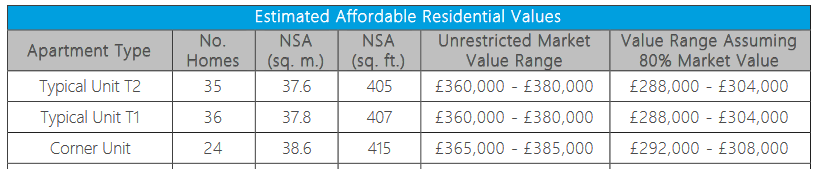 Density and un-exemplary designUnsurprisingly, given Pocket’s ambitions to maximise the number of units, they are proposing a scheme which is twice the density it should be, (at 2,333 habitable rooms per hectare against a maximum allowed of 1,100 hrph), justified on the basis of exemplary design. However, many of the measures for ‘exemplary’ design are not met – it does not have enough amenity space, there is no ‘predominance’ of dual aspect flats, it does not have any 2-bed or more flats, and the flats do not ‘significantly exceed minimum floor-space standards’ 6.Equality not a great considerationThe lack of social and family housing and the provision of all the homes as single bed units, targeted at middle income professionals, would also seem to have clear implications for the various social groups protected under equalities legislation. Southwark have a legal duty to consider this, but have not done so in any detail, content just to note of affordable housing, that there is ‘a high demand for such accommodation and a relatively high BAME population’ 7.Viability and the Bakerloo Line ExtensionThe officer’s report and recommendation for approval was written before press-reports that the Bakerloo Line extension has fallen down the list of priorities for Transport for London (TfL) and may not be built for many years. Pocket Living’s proposal is, according to themselves, technically non-viable and depends upon the delivery of the BLE to turn a profit (as do many other Old Kent Rd schemes) 8. There is no mention of a late stage review of the scheme’s viability, which removes the possibility of any improvement in the affordable housing offer, such as a greater discount in the selling price.The Mayor likes itWhile Pocket Living pretty much ignores Southwark’s own housing policy, so does the officer’s report to the planning committee, which notes the departures, but nonetheless recommends approval on other ‘material’ grounds. The report also cites the enthusiastic support of the Mayor (matching his enthusiasm for Build to Rent, another middle/upper income affordable housing tenure that sacrifices social rent)9.What we say…It is hard to see what this scheme brings to the Old Kent Rd, in housing terms. It has no social housing and no family housing. The affordable housing it does provide is of the most expensive kind. The scheme does not have the private and public space that it should have and it serves a very narrow demographic, while excluding broader sections of the community.Pocket Living would argue that the constraints of the site and the housing needs of a relatively well-off section of the community should outweigh these shortcomings, but Southwark’s local plan already addresses how much housing there should be for different income groups, with the overarching aim of building a mixed and cohesive community. Pocket Living simply ignores this, so the planning committee should reject this application.You can find the 35% Campaign objection to this development here. Footnotes:Southwark’s Core Strategy Strategic Policy 7 – Family homes, pg 86 ↩Officer Report Table pg 42 ↩Officer Report para 133,134,135 ↩Officer Report para 112 ↩New Southwark Plan Submission Version Jan 2020 Fig 2 ↩Officer Report para 118, 119 ↩Officer Report para 28 ↩Officer Report para 64, 65 ↩Officer Report para 229-237; 57 ↩ Density and un-exemplary designUnsurprisingly, given Pocket’s ambitions to maximise the number of units, they are proposing a scheme which is twice the density it should be, (at 2,333 habitable rooms per hectare against a maximum allowed of 1,100 hrph), justified on the basis of exemplary design. However, many of the measures for ‘exemplary’ design are not met – it does not have enough amenity space, there is no ‘predominance’ of dual aspect flats, it does not have any 2-bed or more flats, and the flats do not ‘significantly exceed minimum floor-space standards’ 6.Equality not a great considerationThe lack of social and family housing and the provision of all the homes as single bed units, targeted at middle income professionals, would also seem to have clear implications for the various social groups protected under equalities legislation. Southwark have a legal duty to consider this, but have not done so in any detail, content just to note of affordable housing, that there is ‘a high demand for such accommodation and a relatively high BAME population’ 7.Viability and the Bakerloo Line ExtensionThe officer’s report and recommendation for approval was written before press-reports that the Bakerloo Line extension has fallen down the list of priorities for Transport for London (TfL) and may not be built for many years. Pocket Living’s proposal is, according to themselves, technically non-viable and depends upon the delivery of the BLE to turn a profit (as do many other Old Kent Rd schemes) 8. There is no mention of a late stage review of the scheme’s viability, which removes the possibility of any improvement in the affordable housing offer, such as a greater discount in the selling price.The Mayor likes itWhile Pocket Living pretty much ignores Southwark’s own housing policy, so does the officer’s report to the planning committee, which notes the departures, but nonetheless recommends approval on other ‘material’ grounds. The report also cites the enthusiastic support of the Mayor (matching his enthusiasm for Build to Rent, another middle/upper income affordable housing tenure that sacrifices social rent)9.What we say…It is hard to see what this scheme brings to the Old Kent Rd, in housing terms. It has no social housing and no family housing. The affordable housing it does provide is of the most expensive kind. The scheme does not have the private and public space that it should have and it serves a very narrow demographic, while excluding broader sections of the community.Pocket Living would argue that the constraints of the site and the housing needs of a relatively well-off section of the community should outweigh these shortcomings, but Southwark’s local plan already addresses how much housing there should be for different income groups, with the overarching aim of building a mixed and cohesive community. Pocket Living simply ignores this, so the planning committee should reject this application.You can find the 35% Campaign objection to this development here. Footnotes:Southwark’s Core Strategy Strategic Policy 7 – Family homes, pg 86 ↩Officer Report Table pg 42 ↩Officer Report para 133,134,135 ↩Officer Report para 112 ↩New Southwark Plan Submission Version Jan 2020 Fig 2 ↩Officer Report para 118, 119 ↩Officer Report para 28 ↩Officer Report para 64, 65 ↩Officer Report para 229-237; 57 ↩Read in browser » Shopping Centre closes, but campaign for traders continuesSep 28, 2020 12:00 am Protesters mark the final day for Elephant shopping centre -The closure of the Elephant and Castle shopping centre last Thursday was marked by protest, impassioned speeches and widespread media coverage. The centre closed after 55 years’ service to the local community and is now set to be demolished, to make way for a new retail, leisure and residential complex. Shopping centre owner, Delancey, leads the development partnership behind the new scheme.  While the centre’s major stores had gradually left over the previous months, many of the independent businesses were trading up to the final day. The closure also brought the end for the market which occupied the centre’s ‘moat’, which numbered around 60 stalls just under 2 years ago when Southwark’s planning committee first considered developer Delancey’s proposals for the centre’s redevelopment.Only 40 traders have been relocated to three sites – Castle Square, Perronet House and Elephant Park – ‘leaving about 40 traders who have been trading at least since January 2019 (as per the s106 agreement) without alternative premises’. A major aim now of the traders and their supporters is to secure space that could double the number of relocated traders, with a proposal to the Mayor for new market stalls at the Elephant.Up the Elephant solidarityA large protest organised by the Up the Elephant campaign (which includes the 35% Campaign) marked the centre’s closure and commemorated the people who had worked there, many from for black and ethnic minorities, and its role as a social hub for the Latin American community in particular. The campaign has long fought against the demolition and Delancey’s redevelopment plans and while the centre’s fate was lamented, speakers also noted the gains that the campaign had made – more social housing, affordable retail space as well as new premises for some displaced traders, along with transition and relocation funding. While the centre’s major stores had gradually left over the previous months, many of the independent businesses were trading up to the final day. The closure also brought the end for the market which occupied the centre’s ‘moat’, which numbered around 60 stalls just under 2 years ago when Southwark’s planning committee first considered developer Delancey’s proposals for the centre’s redevelopment.Only 40 traders have been relocated to three sites – Castle Square, Perronet House and Elephant Park – ‘leaving about 40 traders who have been trading at least since January 2019 (as per the s106 agreement) without alternative premises’. A major aim now of the traders and their supporters is to secure space that could double the number of relocated traders, with a proposal to the Mayor for new market stalls at the Elephant.Up the Elephant solidarityA large protest organised by the Up the Elephant campaign (which includes the 35% Campaign) marked the centre’s closure and commemorated the people who had worked there, many from for black and ethnic minorities, and its role as a social hub for the Latin American community in particular. The campaign has long fought against the demolition and Delancey’s redevelopment plans and while the centre’s fate was lamented, speakers also noted the gains that the campaign had made – more social housing, affordable retail space as well as new premises for some displaced traders, along with transition and relocation funding. What the Papers say…There was extensive press and media coverage of the closure and protest, including articles on the SE1 website, Southwark News, South London Press, South West Londoner, Morning Star, The Guardian (and here), the Justice Gap, Vice and the Spanish language Express News UK (and here) and the BBC’s Drivetime with Eddie Nestor. What the Papers say…There was extensive press and media coverage of the closure and protest, including articles on the SE1 website, Southwark News, South London Press, South West Londoner, Morning Star, The Guardian (and here), the Justice Gap, Vice and the Spanish language Express News UK (and here) and the BBC’s Drivetime with Eddie Nestor. Amongst the comments from protest speakers highlighted in SE1 website were those from Patria Roman of Latin Elephant, a mainstay of the campaign, and trader Emad Megahed.Patria expressed her sadness at the closure of the shopping centre but noted that campaigning efforts had yielded improvements in the support provided by developers and the council to local traders.‘I am incredibly proud of all we achieved,’ she said.‘If today we can say that some traders have been relocated, it is because the campaigners fought fiercely. Everything they have is because campaigners fought for it. Nothing came for free.’Emad said – ‘I am so proud of my community. I am proud that my community stuck together – whatever nationality … we all speak the same language, the language of love, and sticking together as one. That’s the lesson we want to teach our kids.’The Guardian noted ‘the shadow of decades of underinvestment’and commented-‘rarely has a managed decline been so obvious, or so long-winded’adding-‘you don’t need to love the shopping centre as it is right now (or at all), or worry about what happens after its demolition to the meeting places, public spaces and social bonds it offers, …. to raise questions about who must leave and who can stay, when the developers arrive in town’. Amongst the comments from protest speakers highlighted in SE1 website were those from Patria Roman of Latin Elephant, a mainstay of the campaign, and trader Emad Megahed.Patria expressed her sadness at the closure of the shopping centre but noted that campaigning efforts had yielded improvements in the support provided by developers and the council to local traders.‘I am incredibly proud of all we achieved,’ she said.‘If today we can say that some traders have been relocated, it is because the campaigners fought fiercely. Everything they have is because campaigners fought for it. Nothing came for free.’Emad said – ‘I am so proud of my community. I am proud that my community stuck together – whatever nationality … we all speak the same language, the language of love, and sticking together as one. That’s the lesson we want to teach our kids.’The Guardian noted ‘the shadow of decades of underinvestment’and commented-‘rarely has a managed decline been so obvious, or so long-winded’adding-‘you don’t need to love the shopping centre as it is right now (or at all), or worry about what happens after its demolition to the meeting places, public spaces and social bonds it offers, …. to raise questions about who must leave and who can stay, when the developers arrive in town’. Southwark News also covers the rebuttal of Southwark Council and Delancey claims that nearly all traders have been satisfactorily relocated. It quotes Latin Elephant, which has profiled those turned down for new premises or unable to find appropriate space, and who say-‘Our research has been widely documented, and it was carried out independently with an effort to enforce transparency and accountability. This has been discussed several times with Southwark Council and Delancey. It is unacceptable to see the closure of the Shopping Centre with many traders still without relocation, so we will continue our advocacy work in a constructive way to support the local community.’The Mayor responds to traders’ proposalA day before the centre’s closure Mayor Sadiq Khan responded to the traders’ proposal for new market stalls to accommodate traders who have not been allocated new premises.Southwark News and The South London Press highlighted the response. The Mayor, quoted in the SLP, says ‘It is disappointing that a number of small businesses still don’t have the certainty they need….in general I would welcome any workable solution that would provide these businesses with the space they need to trade’ while cautioning that the traders’ proposal ‘would be subject to various planning and licensing consents’ making it ‘not appropriate’ to comment on the specific plans being presented.The traders’ proposal is supported by Florence Eshalomi MP, London Assembly member for Lambeth and Southwark, local councillor Maria Linforth-Hall and London Assembly members Caroline Pidgeon and Sian Berry, the Green Party candidate for Mayor. The Camberwell and Peckham Labour Party Constituency Party also passed a motion in support of the traders’ Proposal at their meeting last week.The traders and their supporters will now be building on this support to get new market stalls and kiosks for those traders without new premises and repair some of the damage done to their businesses and livelihoods, by the centre closure. Southwark News also covers the rebuttal of Southwark Council and Delancey claims that nearly all traders have been satisfactorily relocated. It quotes Latin Elephant, which has profiled those turned down for new premises or unable to find appropriate space, and who say-‘Our research has been widely documented, and it was carried out independently with an effort to enforce transparency and accountability. This has been discussed several times with Southwark Council and Delancey. It is unacceptable to see the closure of the Shopping Centre with many traders still without relocation, so we will continue our advocacy work in a constructive way to support the local community.’The Mayor responds to traders’ proposalA day before the centre’s closure Mayor Sadiq Khan responded to the traders’ proposal for new market stalls to accommodate traders who have not been allocated new premises.Southwark News and The South London Press highlighted the response. The Mayor, quoted in the SLP, says ‘It is disappointing that a number of small businesses still don’t have the certainty they need….in general I would welcome any workable solution that would provide these businesses with the space they need to trade’ while cautioning that the traders’ proposal ‘would be subject to various planning and licensing consents’ making it ‘not appropriate’ to comment on the specific plans being presented.The traders’ proposal is supported by Florence Eshalomi MP, London Assembly member for Lambeth and Southwark, local councillor Maria Linforth-Hall and London Assembly members Caroline Pidgeon and Sian Berry, the Green Party candidate for Mayor. The Camberwell and Peckham Labour Party Constituency Party also passed a motion in support of the traders’ Proposal at their meeting last week.The traders and their supporters will now be building on this support to get new market stalls and kiosks for those traders without new premises and repair some of the damage done to their businesses and livelihoods, by the centre closure.Read in browser » Recent Articles:The Elephant traders who face the end without new homes Shopping Centre traders propose new stalls for the Elephant Southwark responds to shopping centre campaignersfollow on Twitter | friend on Facebook | forward to a friend 35% Campaign |
Centre closes, but campaign continues
| Dear Friend Many thanks to all of you who joined us on our great protest to mark the closure of the Elephant and Castle shopping centre last Thursday. The large crowd marched round the shopping centre and heard impassioned and heart-felt speeches from Latin Elephant’s Patria Roman and shopping centre trader Emad Megahed, both mainstays of the Up the Elephant campaign. The protest and closure drew widespread media coverage, with articles in the SE1 website, Southwark News, South London Press, South West Londoner, Morning Star, The Guardian (and an opinion piece), the Justice Gap, Vice and the Spanish language Express News UK (and here) and the BBC’s Drivetime with Eddie Nestor. See More photos of the protest here  Thank’s to Emile for photo What next….. While the centre has closed the campaign in support of the traders continues. The day before the centre’s closure Mayor Sadiq Khan responded to the traders proposal to the Mayor for new market stalls at the Elephant to accommodate traders who have not been allocated new premises. The Mayor has said ‘It is disappointing that a number of small businesses still don’t have the certainty they need….in general I would welcome any workable solution that would provide these businesses with the space they need to trade’. The traders’ proposal is supported by Florence Eshalomi MP, London Assembly member for Lambeth and Southwark, local councillor Maria Linforth Hall and London Assembly members Caroline Pidgeon and Sian Berry, the Green Party candidate for Mayor. The Camberwell and Peckham Constituency Labour Party also passed a motion in support of the traders’ Proposal at their meeting last week. The traders and their supporters will now be building on this support to get new market stalls and kiosks for those traders without new premise and repair some of the damage done to their businesses and livelihoods, by the centre closure. You can read more here. Regards Jerry Copyright © 2020 Elephant Amenity Network, All rights reserved. Our mailing address is: Elephant Amenity Network 18 Market Place Blue Anchor Lane London, Southwark SE16 3UQ United Kingdom |
35% Campaign update – The Elephant traders who face the end without new homes
| Latest blog update on regeneration in Southwark The Elephant traders who face the end without new homes Sep 22, 2020 12:00 am Only 40 traders ‘found new premises’ as centre closure looms -Shopping centre developer Delancey and Southwark Council have mounted a desperate defence of their failed trader’ relocation strategy, with a joint statement claiming that all qualifying businesses have been relocated or offered relocation options ‘without question’. The centre is due to close on Thursday. The very same joint statement reveals, however, that only 40 traders have actually been found new premises through the relocation process, a fraction of the approximately 130 independent businesses identified in January 2018 by Southwark, as operating at the Elephant 1. Much of the rest of the joint statement is a lengthy account of how this much larger figure has been was reduced to just forty traders through the relocation process. The statement also outlines ‘options’ available to the unfortunate traders who have nowhere to go and makes self-justifying excuses for this miserable outcome.  The joint statement also attacks what it calls ‘uncorroborated statistics’, which show that at least 40 traders will have nowhere to go when the centre closes, and online ‘misinformation’. This is clearly aimed at the Up the Elephant campaign, including the 35% Campaign and, in particular, Latin Elephant, who have worked tirelessly to support the traders. Latin Elephant has issued its own rebuttal, noting that Delancey and Southwark have now themselves admitted in the joint statement that only 40 traders have been found new premises, ‘leaving about 40 traders who have been trading at least since January 2019 (as per the s106 agreement) without alternative premises’. Latin Elephant’s rebuttal also includes links to all the supporting research evidence on the fate of traders, through the regeneration process. This research names the independent businesses, maps their location and gives relevant dates. Who gets to be eligible? As Latin Elephant explains, while 130 independent businesses were recognised by Southwark as operating within the red-line of the development in January 2018 (the date of the first hearing for the shopping centre planning application), Delancey and Southwark take only 79 ‘eligible’ businesses as the base-line in their account of the relocation process, excluding many long-standing businesses. Delancey and Southwark then whittle the 79 ‘eligible’ businesses down to forty businesses, in successive stages– 64 applications received, 61 valid, 40 found new premises. (Southwark has acknowledged on its website that there are 33 eligible traders remaining without a relocation offer, but that is not mentioned in the joint statement). The ‘options’ for those not awarded premises are to search for somewhere else themselves, through a commercial premises database. If they do not find anywhere, they will receive payments of around £8000. The inadequacy of these ‘options’ hardly needs stating. The database has been a constant source of frustration to traders, who have criticised it for being out of date and listing premises that are simply too expensive and too far away. An £8000 payment is also very little compensation for the loss of a livelihood, built up over many years and a long way short of what is needed to re-establish a business; one of our previous blogposts has the stories of traders of up to 20 years standing who are in this situation.  No commitments Delancey and Southwark’s joint statement also takes pains to say that there was never a commitment to relocate all the traders. This is shamefully true – it is to Southwark’s great discredit that it ignored evidence from Latin Elephant that this situation was bound to arise, because there was only half the space required for a proper trader relocation in Delancey’s redevelopment plans, but Southwark went ahead and approved the plans nonetheless. Notwithstanding the lack of a formal commitment, Southwark still created the impression that all traders would be accommodated; when asked directly by councillors at the planning meeting for Castle Sq, one of the relocation sites, whether ‘given all of the different site…does that cover…enough sites for all of the current number of traders…..How many short would we be roughly?’ council officers replied ‘…across the piste there should be sufficient’. By their own testimonies traders also confirm that they have been strung along with false hopes of relocation space throughout the relocation process. Stall-holders do it for themselves Faced with the loss of their businesses the market stallholders who occupy the ‘moat’ that surrounds the shopping centre have banded together to draft a Proposal for more market stalls at the Elephant, after the centre’s closure. The Proposal was received by Florence Eshalomi, London Assembly member for Lambeth and Southwark, who met the traders at City Hall, gave strong support and undertook to take up the matter with Mayor Sadiq Khan. Local councillor Cllr Maria Linforth-Hall also met the traders and is giving her support, as are Assembly members Caroline Pidgeon and Sian Berry, Assembly Member and the Green Party candidate for Mayor.  The Camberwell and Peckham Labour Party Constituency Party also passed a motion in support of the traders’ Proposal at their meeting last week. …while UAL looks after itself Sadly, the University of the Arts London (UAL) has not felt able to help the traders, nearly all of whom come from black and ethnic minority backgrounds and despite its professed commitment to Black Lives Matter. In letters received by Southwark Law Centre UAL declines to either withdraw from the shopping centre redevelopment which will supply it with a new campus for the London College of Communication on the very spot traders now occupy, nor to offer support for the traders’ Proposals for additional market stalls. UAL is instead happy to take Southwark and Delancey’s assurances that all traders are being properly treated at face value. Division and attrition Southwark and Delancey’s treatment of the people who actually work at the Elephant now can be summed up as ‘division and attrition’. The relocation strategy and traders’ participation in decisions on their future were only put in place after Delancey had gained planning committee approval for their scheme. Latin Elephant’s advocacy on behalf of all the BAME traders was also resisted. The s106 legal agreement (negotiated between Southwark, Delancey and UAL), which determines who was ‘eligible’ and who was ineligible for relocation support uses formal criteria around leases and licences that do not reflect the way the community has developed over the years. Alongside this, the decline in footfall and in the physical fabric of the centre led to a decline in trade that unsurprisingly meant that traders left before the centre’s closure, wearied beyond hope by the whole ‘regeneration’ process. For Southwark and Delancey this is all part of the natural process of regeneration and relocating just 40 out of 130 traders is a triumph to be proud of. For the traders and the campaigners who support them it is deplorable outcome which exposes the hollow promise that the Elephant and Castle regeneration is providing a ‘fairer future’ for the local community.  Southwark Council’s Planning Framework for E&C regeneration. Southwark Council’s Planning Framework for E&C regeneration.Going, but not forgotten… You can see a short valedictory film, by Emile Scott Burgoyne, celebrating the Elephant community here. See joint statement, heading ‘Who is being relocated?’, first bullet point. ↩ Read in browser » Recent Articles: Shopping Centre traders propose new stalls for the Elephant Southwark responds to shopping centre campaigners The shopping centre traders expelled by regeneration Campaigners demand that UAL withdraws from shopping centre development. follow on Twitter | friend on Facebook | forward to a friend 35% Campaign |

